|
|
re: Real World Models of Propulsion Inspired by Star Trek
 by Major Kelly on 11/28/12 22:55 by Major Kelly on 11/28/12 22:55
Alright, so before I go into this I want to state something:

Thanks for that Roddenberry
Now, I've found theoretical models of both a warp drive and impulse, I figured you guys might be interested.
So, warp drive, actually this one you may have heard of, as they recently made some alterations to reduce the amount of energy required.
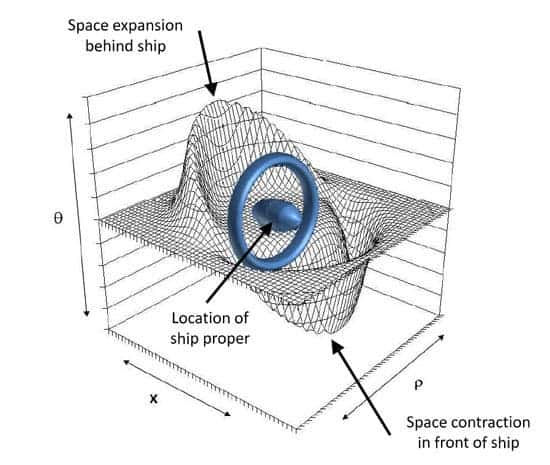
Basically the space in front of the ship is compressed in relation to the ship, meaning the ship travels faster than the speed of light with out breaking the laws of relativity. The ship itself is preserved in an area of "normal space", a "Warp bubble" if you will. The crew would not experience any time dilation effects inside the warp bubble. The area behind the ship is then expanded. Think of it like generating a wave in space time and then riding it.
Copypasta from Wikipedia (the actual name is the Alcubierre Drive)
For those familiar with the effects of special relativity, such as Lorentz contraction and time dilation, the Alcubierre metric has some apparently peculiar aspects. In particular, Alcubierre has shown that even when the ship is accelerating, it travels on a free-fall geodesic. In other words, a ship using the warp to accelerate and decelerate is always in free fall, and the crew would experience no accelerational g-forces. Enormous tidal forces would be present near the edges of the flat-space volume because of the large space curvature there, but by suitable specification of the metric, these would be made very small within the volume occupied by the ship.
The original warp drive metric, and simple variants of it, happen to have the ADM form which is often used in discussing the initial-value formulation of general relativity. This may explain the widespread misconception that this spacetime is a solution of the field equation of general relativity. Metrics in ADM form are adapted to a certain family of inertial observers, but these observers are not really physically distinguished from other such families. Alcubierre interpreted his "warp bubble" in terms of a contraction of space ahead of the bubble and an expansion behind. But this interpretation might be misleading, since the contraction and expansion actually refers to the relative motion of nearby members of the family of ADM observers.
In general relativity, one often first specifies a plausible distribution of matter and energy, and then finds the geometry of the spacetime associated with it; but it is also possible to run the Einstein field equations in the other direction, first specifying a metric and then finding the energy-momentum tensor associated with it, and this is what Alcubierre did in building his metric. This practice means that the solution can violate various energy conditions and require exotic matter. The need for exotic matter leads to questions about whether it is actually possible to find a way to distribute the matter in an initial spacetime which lacks a "warp bubble" in such a way that the bubble will be created at a later time. Yet another problem is that, according to Serguei Krasnikov, it would be impossible to generate the bubble without being able to force the exotic matter to move at local faster than light speeds, which would require the existence of tachyons. Some methods have been suggested which would avoid the problem of tachyonic motion, but would probably generate a naked singularity at the front of the bubble
This method is quite vocal in the news at the moment as NASA is currently running some proof of concept experiments. However, whilst its theoretically possible to start this process, as of yet no one has come up with a method of stopping it yet.
One that you may not have heard of though is Z-Pinch Fusion Impulse. The reason I think this is that I had such a hard time trying to find information out side of scholarly articles about Zeta Pinches application to propulsion.
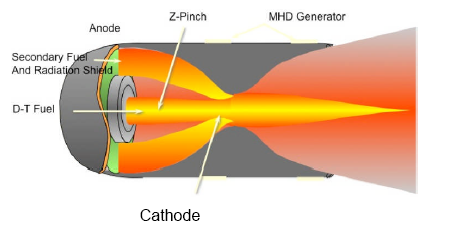
(Zeta Pinch Drive)
Zeta Pinch is an electromagnetic phenomena that happens when you send charged particles along a plasma chamber. In electronics, when you run cable parallel and run current in the same direction the magnetic field pulls the cables together. the same thing is happening when you fire ions down a plasma chamber. They normally form pairs as they are fired and orbit 0 at a fixed distance along the Z or Zeta plane (as in XYZ dimensional planes). If the Z plane is off by any degree they will travel, orbiting 0 at a symmetric distance; so they travel like a helix, if you were to plot their path it would look like someone was trying to draw DNA... and failing :p. The reason for this is that as they move their orbit decays, they get closer together. and as they do so any particles between them get compressed. The charged pair's orbit will decay until a finite point, this point is called a Zeta Pinch. Any matter in between the particles becomes solid, even if they are the charged Ions of the plasma, that means you can have a solid with no electrons, the particles are instead held together by the Zeta Pinch effect.
This has been considered as a catylist for commercial fusion power generation as the force generated by the Zeta Pinch is enough to stimulate deuterium/tritium fusion. As you can imagine this produces a lot of thermal energy, on top of the expansion of the particles as they leave the Zeta Pinch effect. A Zeta Pinch reactor designed in such a way as to direct this thermal energy in such a way as its converted into kinetic energy would produce an efficient method of reaching relativistic speeds.
TL:DR?
SSSSSSSSSPPPPPPPPPPPPPAAAAAAAAAAAAACCCCCCCCCCCEEEEEEEEEE
Last edited by Major Kelly on 11/28/12 23:22; edited 2 times in total
|
|
Anton MercerEngineering - Captain

Awarded:
Joined: 20 Sep 2009
Posts: 1623
|
re: Real World Models of Propulsion Inspired by Star Trek
by Anton Mercer on 11/28/12 23:00
I think Kelly needs to get some type of restriction on what he can post.. :P
|
|
|
|
re: Real World Models of Propulsion Inspired by Star Trek
by Major Kelly on 11/28/12 23:10
| Anton Mercer wrote: | | I think Kelly needs to get some type of restriction on what he can post.. :P |
Take away my Science and Shintaro Kago "My Brain Is Full Of Fuck" and I'm farnsworth:

In fact, I'm already there
Space
Space
I want to go into space.
Dad?
Yes son?
Are you Space?
Yes son, now we are a family again
|
|
Morgan Shackelfordsparrow794Tactical - Vice Admiral

Awarded:
Joined: 17 Jan 2010
Posts: 3119
|
re: Real World Models of Propulsion Inspired by Star Trek
by sparrow794 on 11/28/12 23:29
_________________ 
|
|
|
|
re: Real World Models of Propulsion Inspired by Star Trek
by Major Kelly on 11/28/12 23:51
MFW Star Trek fans don't want discourse about real world theoretical models of FTL and relativistic speeds

... So I turn into Sakuya...
I'm okay with this
|
|
Anton MercerEngineering - Captain
Awarded:
Joined: 20 Sep 2009
Posts: 1623
|
re: Real World Models of Propulsion Inspired by Star Trek
by Anton Mercer on 11/29/12 10:46
| Major Kelly wrote: | MFW Star Trek fans don't want discourse about real world theoretical models of FTL and relativistic speeds
... So I turn into Sakuya...
I'm okay with this |
that anime looks familiar....
|
|
|
|
re: Real World Models of Propulsion Inspired by Star Trek
by Major Kelly on 11/29/12 21:52
| Anton Mercer wrote: | | Major Kelly wrote: | MFW Star Trek fans don't want discourse about real world theoretical models of FTL and relativistic speeds
... So I turn into Sakuya...
I'm okay with this |
that anime looks familiar.... |
http://touhou.wikia.com/wiki/Sakuya_Izayoi
>Anime
Touhou... Its so much more...
Flandre is my favourite
That Feel When you derail your own thread
Feels good man
|
|
|
|